Updated December 16, 2025 07:56PM
No, You Don't Need a Giant Knife to Go Backpacking
Yes, a knife is one of the Ten Essentials. But when it comes to picking a blade, you need far less than many hikers think.
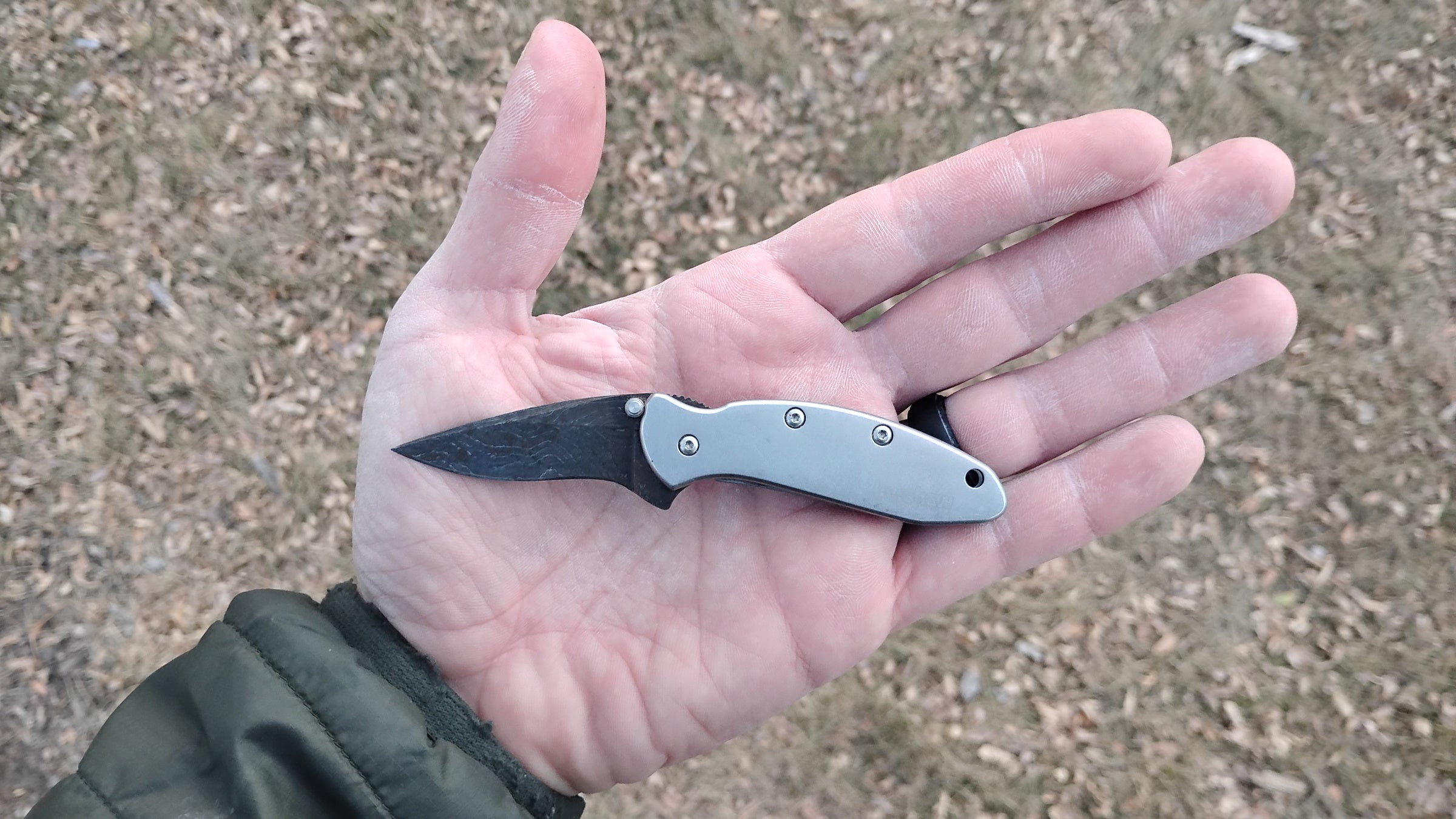
My Kershaw Chive has a blade less than two inches long and has served me well on work trips across five continents. (Photo: Adam Roy)
They were the first hikers we’d seen all day, and they were loaded up. The pair—a father and son, they told us—were heading up into the hills above Curecanti National Recreation Area in Colorado for a weekend. I would have believed they were equipped for a week: Each of them hefted what must have been 80-liter packs, fully swollen with gear, with a tent strapped between the toplid and body of the dad’s pack. And dangling from their belts, each carried a four-inch long Buck knife in a sheath.
Knives have an outsize place in the imagination of the American outdoors. They’re arguably the best-known of the classic Ten Essentials, and learning to use one was one of the first things Boy Scouts of my generation, even washouts like me, had to learn. Survival schools promise to teach students to survive with a bushcraft knife and nothing else. On many trails, it’s not uncommon to encounter people with Davy Crockett-style blades strapped to their hips. But while big, fixed-blade knives may be a potent symbol of wilderness survival, they’re also perfectly useless for hikers.
Don’t get me wrong: There are certainly some things that a knife excels at. It can cut cord for field repairs, shave tinder, and sharpen a stick to use as a stake when one of yours breaks. But all of those tasks have one thing in common: You can do them with a tiny blade. For the past decade, I’ve carried the same knife with me on almost every trip: a Kershaw Chive, a 1.9-inch high-carbon steel pocket knife that weighs in at 1.7 ounces and folds up to the size of my thumb. So far, it’s excelled at everything I’ve needed it to.
Yes, there are things I’ve never tried with that tiny knife. I’ve never built a lean-to, or lashed it to the end of a pole to spearfish. I don’t know if I could use it to skin a deer, and I’m certain I couldn’t baton a log with it. (The only time, in fact, I’ve ever wished I had a bigger blade: car camping along Alberta’s Icefield Parkway, where I had to figure out how to split the wood Parks Canada provided without one.) But that’s the point: across decades of screw-ups, pop-up storms, and wrong turns, I have never needed to do any of those things.
ADVERTISEMENT
In her introductory column for Backpacker in 2023, wilderness survival instructor Jessie Krebs drew a distinction between survival, bushcraft, and ancestral living skills. The latter two are about developing the abilities necessary to live indefinitely in the backwoods—hunting, crafting, and the like. A full-tang bushcraft knife, big enough to work large pieces of wood or split kindling, could be very useful for that. In contrast, she wrote, survival is “a stopgap to keep someone alive until they can return home.” Which of those three approaches applies to you informs which skills you should focus on: Lost hikers don’t need to be able to make their own rope, but knowing how to signal for help is a must.
It also informs what tools you need, and there is not a task that a large-blade knife excels at that a hiker couldn’t accomplish better with something else. When the rain is pounding and the wind is howling, it’s better to have brought a shelter than to build one. Likewise, when I’m lost and hungry, I’d rather find my food in my pack than squished flat under a deadfall trap, covered in fur and filled with squirrel shit. Every news story about a person who survived by roasting snakes over a fire outside their stick-and-leaf hut is also a story about someone who screwed up much earlier in the planning stages, when they could have left those six extra ounces of metal at home and brought a personal locator beacon, or 2,000 more calories, or even a map.
Yes, it’s perfectly possible to bring both a big knife and all other necessities. But too often, we let the gear we don’t need distract us from the gear we do. For an extreme example, see the Arizona hiker who hit a desert trail in 2018 with two large knives and half the water he needed; by the time rescuers picked him up, he was going into kidney failure.
I will throw one bone to the oversized-knife crowd: I like the attitude that their tools imply. We live in a world where our iPhones can contact search and rescue from the deep backcountry at the push of a button. That’s a lifesaving technology, and unambiguously a good thing. But the easier it gets to call in the cavalry, the less of an incentive modern hikers may feel like they have to know how to take care of themselves. Self-sufficiency, in the woods or otherwise, will never stop being cool.
But survival is as much a matter of skill as it is of bringing the right tools, and knowledge doesn’t weigh anything. So trade that big blade for something smaller, and just make sure you know how to use it.
ADVERTISEMENT
Fixed Blades for Backpackers
Looking to mix just a smidge of bushcraft into your backpacking trip? There are plenty of durable fixed-blade knives that are small and light enough for a weight-conscious backpacker to carry. Featuring a 2-inch blade and weighing in at 1.6 ounces with its sheath, the Kershaw Brace is a full-tang, stainless steel knife that’s a few grams lighter than the Chive, though less compact.